Peptilex
EN
The book

Evidence, explained

How strong is the research behind each peptide? Grades, trial phases and the key results – as charts.

The evidence grades

One grade per peptide for its main use – the same scale as in the books. The grade describes how far the research has come, not the substance.

  • AA – Approved medicine, large randomized trials
  • BB – Randomized human trials
  • CC – Small or early human studies
  • DD – Mainly animal studies
  • EE – Mainly cell studies

Evidence grades for all 34 peptides

Where each peptide standsPeptilex evidence grade for the main use

Source: Peptilex evidence grades A–E (Peptilex 1, Appendix A; tracked peptides: weekly review)

From lab to approval

  1. LabCells and molecules: is the mechanism plausible?
  2. AnimalEffects in a living organism.
  3. Phase 1First tests in people: safety and tolerability.
  4. Phase 2Does it work? First signals of benefit.
  5. Phase 3Large randomized trials that confirm the benefit.
  6. ApprovalRegulators review all data.
Registered trials by phaseClinicalTrials.gov · name in study title
ongoing / startingcompleted / other
Phase 1229
Phase 2278
Phase 3346
Phase 4226
Other296

Source: PubMed and ClinicalTrials.gov via the Peptilex study database

Trial starts per yearClinicalTrials.gov · by start date (planned starts included)
58
482017
45
842019
47
802021
86
1052023
126
1332025
157
122027

Source: PubMed and ClinicalTrials.gov via the Peptilex study database

Key results as charts

Average weight loss in landmark trials% of body weight · treatment vs placebo
TreatmentPlacebo
RetatrutideTRIUMPH-1 · 80 wk¹
25.0%
3.9%
TirzepatideSURMOUNT-1 · 72 wk¹
20.9%
3.1%
CagriSemaREDEFINE 1 · 68 wk
20.4%
3.0%
SemaglutideSTEP 1 · 68 wk
14.9%
2.4%

¹ Highest-level treatment group. Different trials, durations and populations – not a head-to-head comparison.

Sources: TRIUMPH-1 · NEJM 2026 · SURMOUNT-1 · NEJM 2022 · REDEFINE 1 · NEJM 2025 · STEP 1 · NEJM 2021

Average weight loss in landmark trialsTrialTreatmentPlacebo
RetatrutideTRIUMPH-125.0%3.9%
TirzepatideSURMOUNT-120.9%3.1%
CagriSemaREDEFINE 120.4%3.0%
SemaglutideSTEP 114.9%2.4%
Head-to-head% of body weight · vs semaglutide in the same trial
TreatmentSemaglutide
TirzepatideSURMOUNT-5 · 72 wk
20.2%
13.7%
CagriSemaREDEFINE 5 · 2026
18.4%
11.9%

Sources: SURMOUNT-5 · NEJM 2025 · REDEFINE 5 · 2026

Beyond the scale: semaglutideOutcomes in large randomized trials
20%fewer heart attacks, strokes or cardiovascular deathsSELECT · 17,604 people · NEJM 2023
24%fewer major kidney eventsFLOW · 3,533 people · NEJM 2024
TreatmentPlacebo
MASH resolvedESSENCE · 72 wk
62.9%
34.3%

Sources: SELECT · NEJM 2023 · FLOW · NEJM 2024 · ESSENCE · NEJM 2025

Complete corneal healingNeurotrophic keratopathy · phase 3
Thymosin beta-4 eye drops
6 of 10
Placebo
1 of 8

Source: SEER-1 · Int J Mol Sci 2022 · 18 participants

Healing & immune peptides: human results% · treatment vs comparison group
TreatmentComparison
GHK-Cu gelMedian wound closure · Mulder et al.
98.5%
60.8%
Thymosin alpha-1Complete response, chronic hepatitis B · Chien et al.
40.6%
9.4%

Sources: Mulder et al. · Wound Repair Regen 1994 · Chien et al. · Hepatology 1998

Study labels

Meta-analysisSystematic reviewHuman RCTClinical trialHuman studyCase reportAnimal studyLab studyRegistered trialApproved medicine

Glossary

Accelerated approval
A US pathway that allows approval based on a measure reasonably likely to predict benefit, with confirmatory trials required afterwards.
Agonist
A substance that activates a receptor.
Amino acid
The basic building block of peptides and proteins.
AMPK
An enzyme that acts as the cell's energy sensor.
Analogue
A modified version of a natural substance.
Angiogenesis
The formation of new blood vessels.
Bioavailability
The share of a substance that reaches the bloodstream and its target.
Blinding
Keeping participants and/or researchers unaware of who receives the real treatment, to avoid bias.
Evidence grade
The Peptilex rating from A to E describing how strong the evidence for a use is.
GHRH
Growth hormone–releasing hormone, the hypothalamic signal that stimulates growth hormone release.
GHRP
Growth hormone–releasing peptide, a synthetic peptide acting on the ghrelin receptor.
GLP-1
Glucagon-like peptide-1, a gut hormone that boosts insulin release and promotes fullness.
IGF-1
Insulin-like growth factor 1, a hormone produced mainly in the liver in response to growth hormone.
Immunogenicity
The ability of a substance to provoke an immune response.
In vitro / in vivo
In the laboratory (cells, test tubes) / in a living organism.
Meta-analysis
A statistical combination of the results of several studies.
Off-label
Use of an approved medicine for a purpose, group or form not covered by its approval.
Peptide
A short chain of amino acids, roughly 2 to 50.
Phase 1, 2, 3
Stages of clinical trials, from first safety testing in small groups to large confirmatory trials.
Placebo
An inactive comparison treatment.
Randomized controlled trial (RCT)
A study in which participants are assigned by chance to treatment or comparison groups.
Receptor
A protein on or in a cell that recognizes a specific signal.
Secretagogue
A substance that causes another substance to be released.
Surrogate marker
A measurement (such as a blood value) used in place of a real health outcome.
Telomeres
Protective caps at the ends of chromosomes.

Go deeper

All 34 peptides in one book

Every profile: what it is, the key studies, the evidence grade and where it stands in 2026.
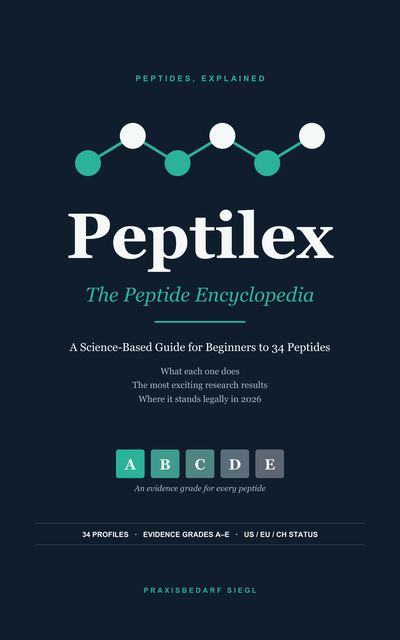
Peptilex – The Peptide Encyclopedia, book cover

Peptilex – The Peptide Encyclopedia

  • 34 peptides – from semaglutide to BPC-157 – in one book
  • An evidence grade (A–E) and the key studies for every peptide
  • Where each one stands in 2026 – US, EU and Switzerland

Formats: Kindle · Paperback · Hardcover

Amazon store: amazon.com · Change store

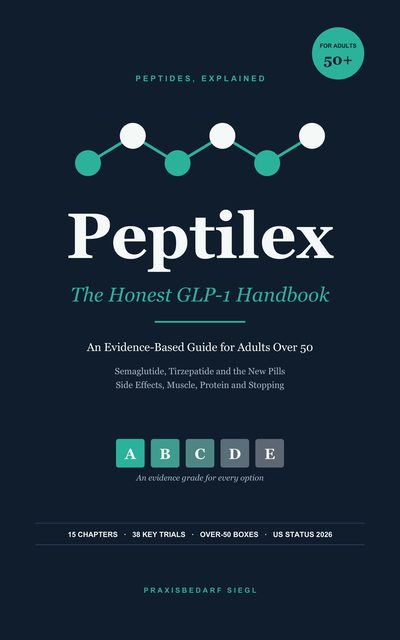
Peptilex – The Honest GLP-1 Handbook, book cover
Coming soonPeptilex – The Honest GLP-1 HandbookSemaglutide, tirzepatide and the new pills, explained for adults over 50.
The Peptide Encyclopediaamazon.com
View on Amazon